When we walk down a bustling city sidewalk or drive across an urban intersection, we rarely look down at the metal discs anchoring our streets. Yet, these humble components represent one of the greatest triumphs of modern utility infrastructure.
Manhole covers are the unsung sentinels of civil engineering. They preserve structural safety, provide vital municipal access, and withstand millions of tons of heavy transit load day in and day out.
The story of their evolution is a fascinating journey from brittle, heavy stone to advanced metallurgy. At the pinnacle of this modern evolution stands the KAJ Brand—a benchmark name synonymous with high-performance ductile iron casting and engineering excellence.
1. The Pre-Industrial Subterranean Foundations
Before the industrial era, municipal access points were primitive. Ancient Roman systems utilized chiseled stone slabs to cover access points to their famed aqueducts and Cloaca Maxima.
While stone was readily available, it lacked the tensile strength required for shifting terrains, was highly susceptible to structural cracking under concentrated loads, and was incredibly cumbersome to displace for routine maintenance.
2. The Gray Iron Era: Power and Its Brittle Limitations
With the dawn of the Industrial Revolution and the massive expansion of subterranean water, gas, and early electrical grids, civil engineers required a uniform, mass-produced alternative to stone. Enter Gray Cast Iron (GG).
Why Gray Iron Dominated
For over a century, gray iron was the undisputed global standard. It offered excellent castability, high compressive strength, and natural corrosion resistance.
The Fatal Flaw
Despite its compressive strengths, gray iron contains a microstructure dominated by graphite flakes. These sharp flakes act as internal stress concentrators. Under heavy impacts or sudden weight shifts, gray iron displays minimal elongation and poor impact resistance. It does not bend; it breaks.
As heavy commercial trucking replaced horse-drawn wagons in the mid-20th century, standard gray iron covers began cracking under dynamic traffic stresses, presenting catastrophic risks to vehicular traffic and pedestrians alike.
3. The Metallurgy Revolution: The Birth of Ductile Iron
The true paradigm shift in civil engineering occurred with the development of Ductile Iron (also known as Nodular or Spheroidal Graphite Iron).
By introducing a small, controlled amount of magnesium into the molten iron matrix just prior to casting, metallurgists fundamentally changed the way graphite behaves within the metal. Instead of forming sharp, crack-inducing flakes, the graphite coalesces into perfect micro-spheres (nodules).
[Gray Iron Microstructure] ---> [Ductile Iron Microstructure]
Graphite forms sharp flakes Graphite forms spherical nodules
(High stress, brittle fracture) (Distributes stress, high elongation)
This structural shift provides remarkable benefits:
4. The KAJ Brand: Perfecting the Craft of Municipal Castings
As the engineering community transitioned to ductile iron, the KAJ Brand emerged as a vanguard of quality, engineering its products to address the real-world operational challenges faced by municipal departments and civil contractors.
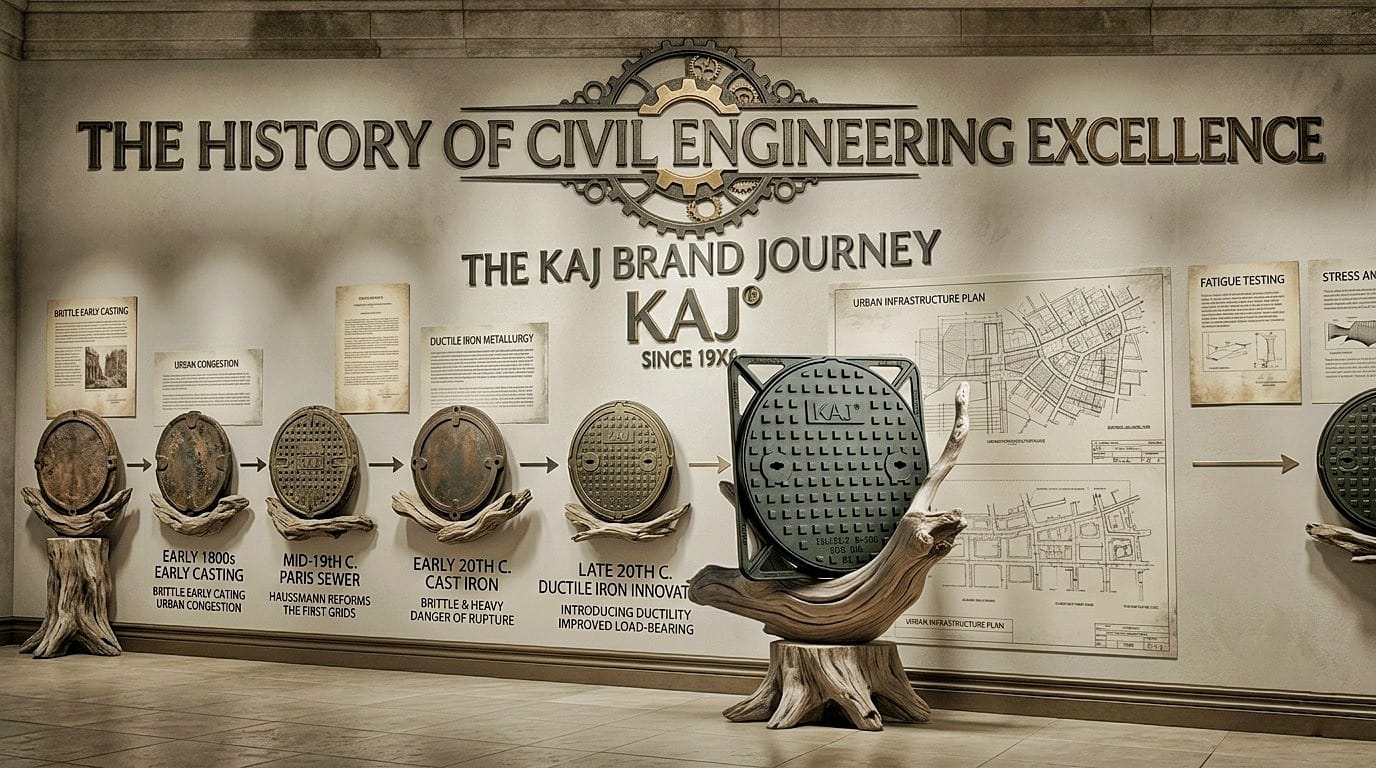
The evolution of KAJ Brand ductile iron covers showcases how foundational metallurgy transforms into precision asset management.
Engineering Load Optimization
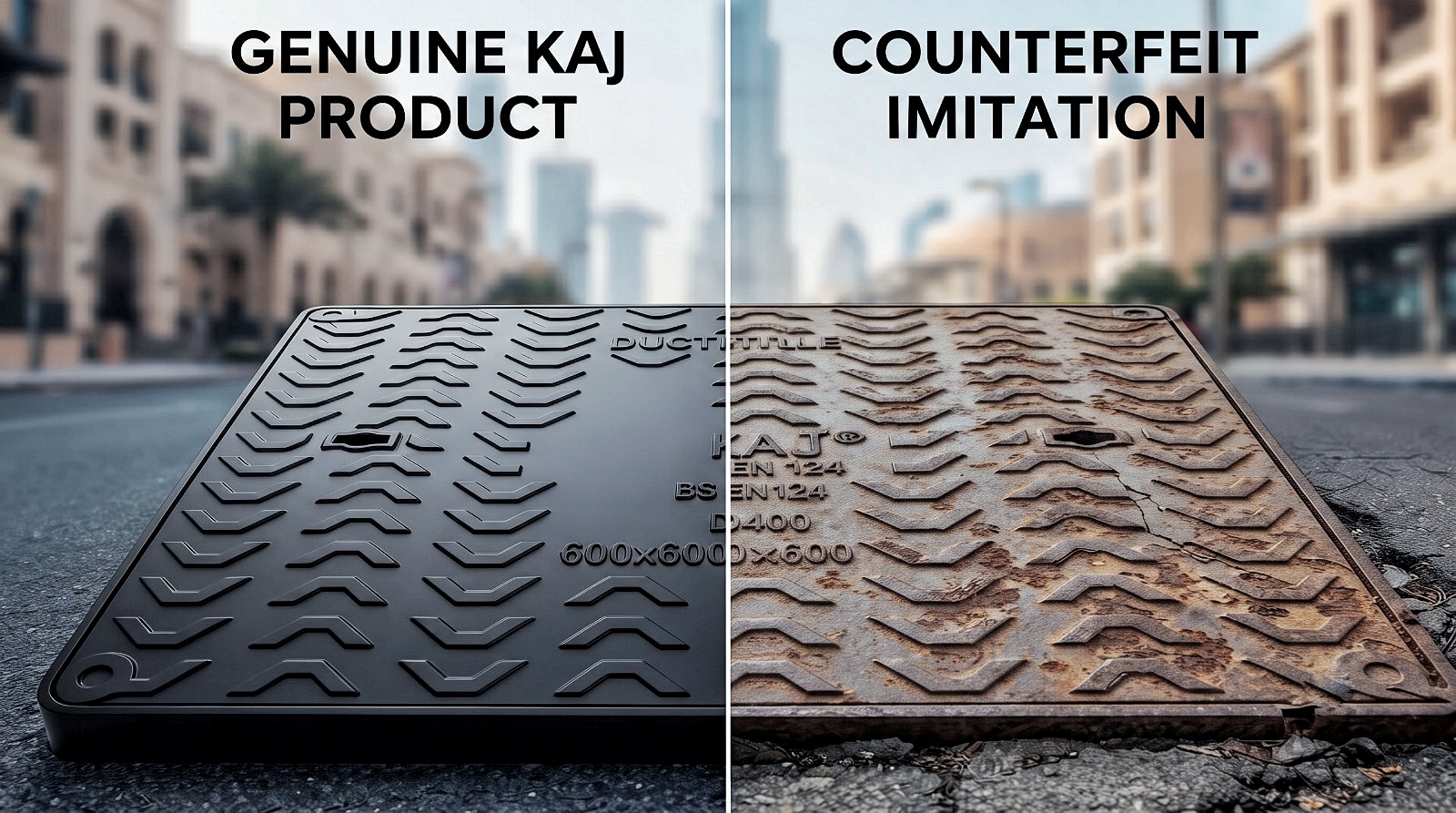
KAJ products are precisely manufactured to align with strict international load classification standards (such as EN 124). From Class B125 (footways and car parks) to Class D400 (main traffic highways) and Class F900 (airport runways), KAJ has refined the structural ribbing on the underside of its covers to maximize load distribution while shedding unnecessary material weight.
The Anti-Theft & Security Evolution
In modern urban management, infrastructure theft (for scrap metal value) and unauthorized utility access present massive liabilities. KAJ pioneered integrated hinge systems and advanced ergonomic locking mechanisms directly into their ductile profiles. These systems ensure the cover remains anchored to its frame during high-velocity traffic impacts while allowing authorized crews rapid, leverage-assisted access.
Eliminating the "Street Rattle"
Traditional manhole covers are notorious for shifting and creating a loud, disruptive metallic rattling sound when driven over. The KAJ Brand eliminated this urban nuisance by introducing precision-machined seating faces and integrated sound-damping EPDM/elastomeric gaskets. This creates a secure, silent, and watertight seal that mitigates sub-surface frame wear.
The Modern Standards at a Glance
| Feature | Legacy Gray Iron Covers | KAJ Ductile Iron Covers |
| Feature | Legacy Gray Iron Covers | KAJ Ductile Iron Covers |
|---|---|---|
| Primary Microstructure | Graphite Flakes (Brittle) | Spheroidal Graphite Nodules (Elastic) |
| Weight-to-Strength Ratio | Heavy profile required for basic load | Lightweight, optimized structural ribbing |
| Failure Mode | Sudden, catastrophic cracking | Gradual deformation under extreme stress |
| Noise & Stability | Prone to shifting and rocking noise | Precision machined with sound-damping gaskets |
| Security Features | Loose fit; highly vulnerable to theft | Integrated hinge options and heavy-duty locks |
5. The Future of Smart Infrastructure
Today, the KAJ Brand continues to evolve alongside the concept of "Smart Cities." Modern KAJ manhole covers are engineered to be radio-frequency neutral, allowing municipalities to install sub-surface smart sensors (monitoring sewer gas levels, acoustic flow rates, or flood warnings) that transmit telemetry seamlessly through the ductile structure without lifting the lid.
From the chiseled stones of ancient empires to the high-tensile, smart-ready castings of the KAJ Brand, the evolution of the manhole cover is a testament to civil engineering excellence. By transforming a basic road asset into a durable, secure, and ergonomic piece of structural art, KAJ continues to pave the way for safer, quieter, and more resilient urban landscapes.